
Restoration of degraded forest ecosystems and economic valorization of ecosystem utilities: Socio-economic impacts of forest restoration
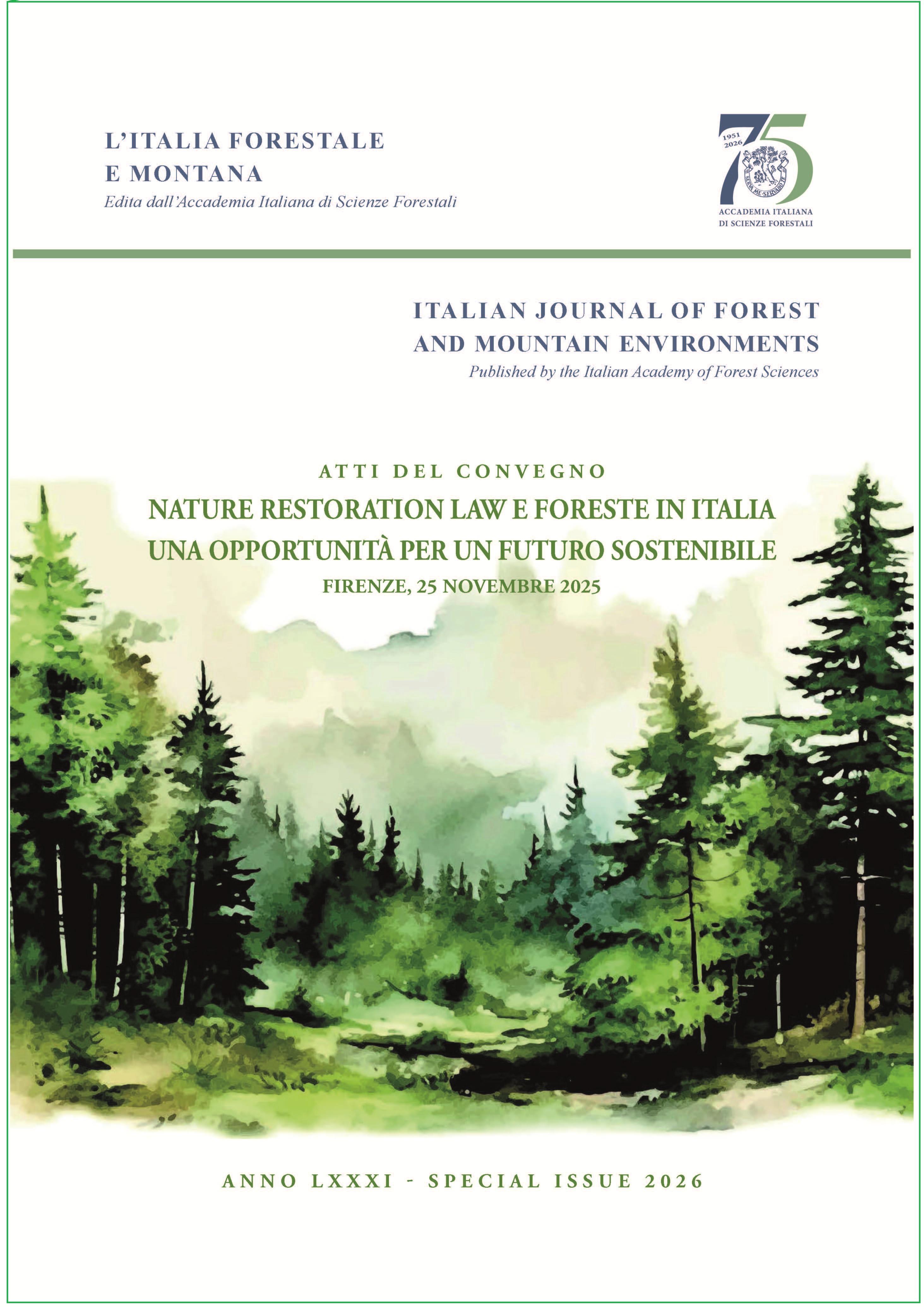
Published 2026-06-08
Keywords
- restoration actions,
- ecosystem benefits,
- market instruments,
- Payments for Ecosystem Services (PES) schemes
How to Cite
Copyright (c) 2026 Enrico Marone, Alessandro Paletto, Severino Romano, Sandro Sacchelli

This work is licensed under a Creative Commons Attribution-NonCommercial 4.0 International License.
Abstract
EU Regulation 2024/1991 lays the foundation for natural ecosystem restoration interventions to be defined and implemented through National Restoration Plans. Forest ecosystems can benefit significantly from management interventions that strengthen ecological functionality and positive socioeconomic impacts from the local to national levels. In this context, this contribution aims to provide an initial analysis of possible forms of direct contributions, public funding, public-private investments, or alternative forms of financial support (such as Payments for Forest Ecosystem Services) for the implementation of restoration interventions, as indicated in Article 15 of the Nature Restoration Regulation.
References
- Baldessari, S., Becagli, C., De Meo, I., Giordano, D., & Paletto, A. (2025). Nature Restoration Law: Quali potenziali implicazioni per le foreste? Dendronatura, 46(1), 110-123.
- Bateman, I. J., Carson, R. T., Day, B., Hanemann, M., Hanley, N., Hett, T., Jones-Lee, M., Loomes, G., Mourato, S., Özdemiroglu, E., Pearce, D., Sugden, R., & Swanson, J. (2002). Economic valuation with stated preference techniques: A manual. Edward Elgar Publishing. https://doi.org/10.4337/9781781009727
- Bishop, R. C., & Romano, D. (1998). Environmental resource valuation: Applications of the contingent valuation method in Italy. Kluwer Academic Publishers. https://doi.org/10.1007/978-1-4615-5741-8
- Chaudhry, S., Singh Sidhu, G. P., & Paliwal, R. (2021). Restoring ecosystem services of degraded forests in a changing climate. In M. N. Vara Prasad (Ed.), Handbook of ecological and ecosystem engineering (pp. 353-375). John Wiley & Sons. https://doi.org/10.1002/9781119678595.ch19
- Corona, P., Bernardini, V., Iovino, F., Lisa, C., Paletto, A., Plutino, M., Sacchelli, S., Vangi, E., Travaglini, D., & Nocentini, S. (2025). Utilità ecosistemiche e valorizzazione selvicolturale dei rimboschimenti di conifere (Rete Rurale Nazionale 2014-2020, Scheda 22.2 - Foreste). Consiglio per la ricerca in agricoltura e l›analisi dell›economia agraria.
- Department for Environment, Food and Rural Affairs (DEFRA). (2013). Payments for ecosystem services: A best practice guide. https://assets.publishing.service.gov.uk/government/uploads/system/uploads/attachment_data/file/200920/pb13932-pes-bestpractice-20130522.pdf
- Gann, G. D., McDonald, T., Walder, B., Aronson, J., Nelson, C. R., Jonson, J., Hallett, J. G., Eisenberg, C., Guariguata, M. R., Liu, J., Hua, F., Echeverría, C., Gonzales, E., Shaw, N., Decleer, K., & Dixon, K. (2019). International principles and standards for the practice of ecological restoration. Restoration Ecology, 27, S1-S46. https://doi.org/10.1111/rec.13035
- Grilli, G., Fratini, R., Marone, E., & Sacchelli, S. (2020). A spatial-based tool for the analysis of payments for forest ecosystem services related to hydrogeological protection. Forest Policy and Economics, 111, 102039. https://doi.org/10.1016/j.forpol.2019.102039
- Hausman, J. A. (1993). Contingent valuation: A critical assessment (Vol. 220). Elsevier. https://doi.org/10.1108/S0573-8555(1993)220
- Kangas, J., Kullberg, P., Pekkonen, M., Kotiaho, J. S., & Ollikainen, M. (2021). Precision, applicability, and economic implications: A comparison of alternative biodiversity offset indexes. Environmental Management, 68, 170-183. https://doi.org/10.1007/s00267-021-01488-5
- Kangas, J., & Ollikainen, M. (2023). Reforming a pre-existing biodiversity conservation scheme: Promoting climate co-benefits by a carbon payment. Ambio, 52, 1847-1860. https://doi.org/10.1007/s13280-023-01833-4
- Kangas, J., & Ollikainen, M. (2025). Towards an efficient implementation of the EU biodiversity strategy in forests - An analysis of alternative voluntary conservation mechanisms and selection criteria. Forest Policy and Economics, 172, 103448. https://doi.org/10.1016/j.forpol.2025.103448
- Kotiaho, J. S., Kuusela, S., Nieminen, E., Paivinen, J., & Moilanen, A. (2016). Framework for assessing and reversing ecosystem degradation (Reports of the Ministry of the Environment 15en). Ministry of the Environment.
- Lees, E., & Pedersen, O. W. (2025). Restoring the regulated: The EU’s Nature Restoration Law. Journal of Environmental Law, 37, 75-96. https://doi.org/10.1093/jel/eqae032
- Lipper, L. (2000). Forest degradation and food security. Unasylva, 202(51).
- Lund, H. G. (2009). What is a degraded forest. Forest Information Services.
- Marone, E., & Sacchelli, S. (2023). Dalla Legge Serpieri alla valorizzazione e remunerazione delle utilità ecosistemiche nella visione del bosco quale sistema complesso. In Arrigo Serpieri - Un grande maestro (pp. 275-292). Accademia dei Georgofili.
- Marquard, E., Hermsdorf, M., Dahms, H., Schleicher, K., Strunz, S., Baron, M., Salomon, M., Schmid, H.-L., Wiegand, S., Hornberg, C., Farwig, N., Wolters, V., Bauhus, J., Feindt, P. H., Köck, W., & Settele, J. (2025). Underpinning the EU Nature Restoration Regulation: Five success factors for effective measures in the Member States. Restoration Ecology, 33, e70121. https://doi.org/10.1111/rec.70121
- Matzdorf, B., Sattler, C., & Engel, S. (2013). Institutional frameworks and governance structures of PES schemes. Forest Policy and Economics, 37, 57-64. https://doi.org/10.1016/j.forpol.2013.10.002
- Mäler, K. G. (1974). Environmental economics: A theoretical inquiry. Johns Hopkins University Press.
- Merlo, M. (1991). Elementi di economia ed estimo forestale-ambientale. Patròn Editore.
- Merlo, M., & Croitoru, L. (2005). Valuing Mediterranean forests: Towards total economic value. CABI International. https://doi.org/10.1079/9780851999975.0000
- Ministero dell’Agricoltura, della Sovranità Alimentare e delle Foreste (MASAF). (2022). Piano Strategico Nazionale della PAC 2023-2027 (PSP) (Versione 11.2.2026). https://www.reterurale.it/flex/cm/pages/ServeBLOB.php/L/IT/IDPagina/24037
- Mitchell, R. C., & Carson, R. T. (1989). Using surveys to value public goods: The contingent valuation method. Resources for the Future.
- Pacheco, P., Beatty, C., & Patel, J. (2024). An economic view on the costs and benefits of forest restoration. In P. Katila, C. J. Pierce, W. de Jong, G. Galloway, P. Pacheco, & G. Winkel (Eds.), Restoring forests and trees for sustainable development: Policies, practices, impacts, and ways forward (pp. 238-260). Oxford University Press. https://doi.org/10.1093/9780197683958.003.0009
- Pearce, D. (2001). The economic value of forest ecosystems. Ecosystem Health, 7(4), 284-296. https://doi.org/10.1046/j.1526-0992.2001.01037.x
- Perissi, I. (2025). Assessing the EU27 potential to meet the Nature Restoration Law targets. Environmental Management, 75, 711-729. https://doi.org/10.1007/s00267-024-02107-9
- Quiroga, S., Suarez, C., Ficko, A., Feliciano, D., Bouriaud, L., Brahic, E., Deuffic, P., Dobsinska, Z., Jarsky, V., Lawrence, A., & Nybakk, E. (2019). What influences European private forest owners’ affinity for subsidies? Forest Policy and Economics, 99, 136-144. https://doi.org/10.1016/j.forpol.2018.08.008
- Randall, A. (1987). Total economic value as a basis for policy. Transactions of the American Fisheries Society, 116, 325-335. https://doi.org/10.1577/1548-8659(1987)116<325:TEVAAB>2.0.CO;2
- Rete Rurale Nazionale. (2023). Le foreste e il settore forestale nelle politiche di sviluppo rurale. https://www.reterurale.it/flex/cm/pages/ServeBLOB.php/L/IT/IDPagina/24832
- Ringier, S. U., Mitani, Y., Schweier, J., & Lindhjem, H. (2025). Enhancing engagement: A European meta-analysis of forest owner preferences in voluntary agreements for the provision of biodiversity and ecosystem services. Ecosystem Services, 76, 101772. https://doi.org/10.1016/j.ecoser.2025.101772
- Romano, R., & Perinotto, M. (2025, 18 marzo). Gli interventi forestali del Piano Strategico della PAC [Comunicazione]. Workshop RRN PSP PAC 2023-2027.
- Romano, S. (2007). La valutazione degli investimenti ambientali. In I. Bernetti & S. Romano (A cura di), Economia delle risorse forestali (pp. 389-436). Liguori Editore.
- Signorello, G. (2007). La valutazione economica del paesaggio. Aestimum, 83-102. https://doi.org/10.13128/Aestimum-8136
- Süring, C. M., & Lundhede, T. H. (2025). Private forest owner preferences for action- and result-based biodiversity restoration contracts - A discrete choice experiment in Denmark and Finland. Forest Policy and Economics, 179, 103609. https://doi.org/10.1016/j.forpol.2025.103609
- Tedesco, A. M., Brancalion, P. H. S., Hak Hepburn, M. L., Walji, K., Wilson, K. A., Possingham, H. P., Dean, A. J., Nugent, N., Elias-Trostmann, K., Perez-Hammerle, K. V., & Rhodes, J. R. (2022). The role of incentive mechanisms in promoting forest restoration. Philosophical Transactions of the Royal Society B: Biological Sciences, 378(1867). https://doi.org/10.1098/rstb.2021.0088
- Vásquez-Grandón, A., Donoso, P. J., & Gerding, V. (2018). Forest degradation: When is a forest degraded? Forests, 9(11), 726. https://doi.org/10.3390/f9110726
- Verdone, M. (2015). A cost-benefit framework for analyzing forest landscape restoration decisions. International Union for Conservation of Nature (IUCN).
- Wunder, S. (2005). Payments for environmental services: Some nuts and bolts (CIFOR Occasional Paper No. 42). Center for International Forestry Research (CIFOR). https://www.cifor.org/publications/pdf_files/OccPapers/OP-42.pdf
- Zandvliet, J. (2025). Making the Nature Restoration Regulation a local success… Exploring policy instruments for the implementation of the European Nature Restoration Regulation in the Dutch multi-level governance system [Paper]. Forest and Nature Conservation Policy.